The 15-Minute Cure: Why Traditional Structural Restoration Strategies are Failing
The 15-Minute Cure: Why Traditional Structural Restoration Strategies are Failing
The Hidden Decay of Our Structures
The signs are unmistakable to the trained eye The 15-Minute Cure: Why Traditional Structural Restoration Strategies are Failing delamination of the surface, cracking along the line of reinforcement, and the inevitable “concrete cancer”—the expansion of ferrous oxide that forces concrete to spall and crumble. This structural ailment is more than a maintenance headache; it is a progressive failure of the building’s skeletal integrity.
For years, remediation was a cumbersome process of patchwork and temporary fixes. However, as a senior consultant in the field, I have seen the paradigm shift toward “surgical” restoration. By utilizing advanced mortars like Drizoro Maxrest and Maxrite 700, we are no longer just filling holes; we are chemically and mechanically re-engineering the bond between steel and stone.
The 15-Minute Structural Bond: Why Speed Matters
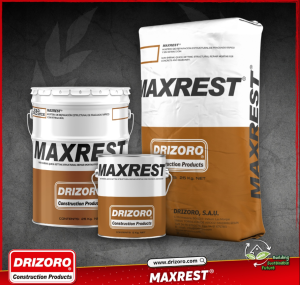
In structural repair, speed is historically the enemy of performance. Most rapid-set materials suffer from high heat of hydration, leading to shrinkage and micro-cracking. Maxrest upends this convention, achieving a structural set in just 15 to 20 minutes without compromising the integrity of the substrate.
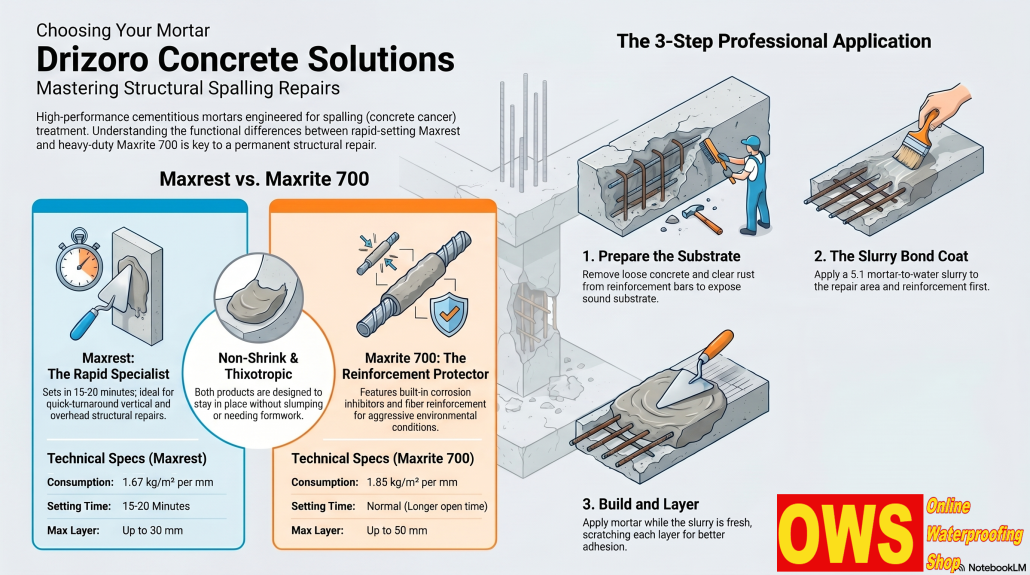
This is a critical efficiency for high-traffic or high-stakes infrastructure. With a consumption rate of approximately 1.67 kg/m² per 1 mm of thickness (where 1 kg fills 0.6 litres), Maxrest becomes an integral part of the substrate. It achieves a mechanical strength comparable to, or exceeding, the original concrete.
Maxrest DOES NOT slump or need formwork, does not shrink or crack when setting.
This rapid-setting characteristic eliminates the wait-times associated with traditional masonry, significantly reducing labor costs and allowing for single-phase repairs that are structurally sound almost immediately upon application.
Gravity-Defying Repair: Eliminating the Need for Formwork
The most significant cost-driver in overhead or vertical repair is “formwork”—the complex wooden molds required to keep mortar from succumbing to gravity. The sophisticated thixotropic nature of these Drizoro products renders formwork obsolete.
Thixotropy allows the mortar to remain in a “non-slump” state; it is stiff enough to stay in place when applied but becomes workable under the pressure of a trowel. This democratizes even the most difficult overhead repairs. By simply trowelling the material into the repair zone, the process is streamlined into a direct application that stays where it is placed. This non-slump characteristic is counter-intuitive for structural materials, yet it is exactly what allows for the restoration of lines and shapes in damaged prefabricated elements without architectural compromise.
The “Envelope” Technique: Surrounding the Source of the Problem
A permanent restoration requires more than a surface patch; it requires the “envelope” technique. To truly halt corrosion. All unsound concrete must be removed until the reinforcement bars (reo) no longer show rust. Using professional tools—such as a needle gun, wire brush, or sandblasting—the reo must be cleaned to a bright metal finish.
We don’t just clear the face of the bar; we excavate the concrete all the way around the reinforcement to create a minimum 1 cm gap. This allows the mortar to “envelope” the bar, creating a protective, alkaline seal that passivates the steel.
The process begins with a “slurry coat” primer—a 5:1 mix of product to water—applied to the damp substrate and the bars. While this slurry is fresh. Apply Maxrest in successive layers between 2.5 and 3 cm thick. This ensures a monolithic bond that mechanically locks the reinforcement back into the structure.
More Than a Filler: The “Active Defense” of Maxrite 700
While Maxrest is the standard for rapid work, Maxrite 700 is our premium “Active Defense” system. Silica fume-enhanced and polymer-modified. They specifically engineered for aggressive environments like marine zones, sewers, or areas plagued by carbonation and acid rain.
Unlike passive fillers, Maxrite 700 contains active corrosion inhibitors that provide an chemical shield for the internal steel. It allows for high-build applications, with layer thicknesses ranging from 5 mm up to 50 mm in a single pass.
Corrosion inhibitors prevent corrosion against chlorides and aggressive corroding agents, extending considerably the service life of the structure.
Investing in Maxrite 700 is an investment in the structure’s lifecycle. It is waterproof, withstands freeze/thaw cycles, and offers high resistance to carbonation, effectively “future-proofing” the repair against environmental wear.
Safety in the Shadows: Non-Toxic Repairs for Tight Spaces
Infrastructure maintenance often forces crews into confined, poorly ventilated spaces—water tanks, shafts, or sewers. In these environments, solvent-based or toxic materials are a significant safety liability.
Drizoro mortars are surprisingly benign: they are non-toxic, odour-free, and chloride-free. This makes them the gold standard for drinking water reservoirs and other sensitive infrastructure. They provide heavy-duty structural restoration without introducing harmful volatiles into the workspace or the water supply, removing air-quality barriers that often stall critical maintenance projects.
You have learnt when your Building for the Next Century
Surgical restoration is not merely about the application; it is about the “cure.” A Senior Consultant knows that the job isn’t finished until the material is properly hydrated.
Under heat or wind:
The repair must be covered with a wet cloth or mist-sprayed for at least one hour to ensure the chemical reaction reaches full potential.
By moving away from temporary bandages and toward advanced, thixotropic, and corrosion-inhibiting mortars, we shift the focus to permanent structural health. This strategy safeguards your assets and slashes ongoing maintenance costs for decades.
The question for every asset owner remains: If your structure is currently battling “concrete cancer,” are you applying a temporary bandage or a permanent cure?
The 15-Minute Cure: Why Traditional Structural Restoration Strategies are Failing
Test your knowledge Click on the botton below